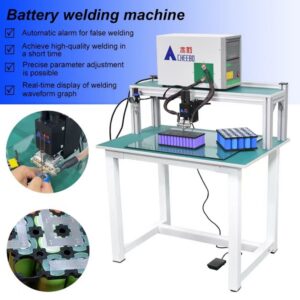
Battery Spot Welding Machine LithiumBatterySpotWelder
Lithium battery spot welding machines belong to the category of resistance welding machines. Resistance welding is suitable for metal-to-metal welding. Its basic structure consists of welding heads that clamp the metal and apply pressure, along with a welding power supply that outputs current.
So, what is resistance welding? And why can metal be welded together?
Resistance is the force that opposes the direction of movement. Similar to the heat generated by friction during braking, heat is also produced when electrical current flows through metals. When current passes between two metal pieces, both the resistance of the metal itself and the contact resistance at the joint generate heat. Resistance welding uses this pressure and heat to join metals together.
The metals to be welded are overlapped and pressure is applied. In this condition, electricity flows through the contact area. The greater the resistance between the metals, the easier it is to generate heat, causing the metals to melt and fuse together.
The method of using Joule heat generated by the contact resistance between metals to melt and weld the metals together is called resistance welding.
Next, let us take a detailed look at the main components of a lithium battery spot welding machine. 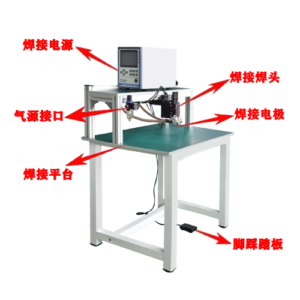
Welding Power Supply
The welding power supply delivers current between two metal pieces. It provides the required current for the welding material and allows adjustment of the welding current and welding time.
Welding current value: adjustable
Welding time: adjustable
According to different power supply methods, there are four main types of welding power supplies:
AC Welding Power Supply
The AC welding power supply is the most widely used type. It features a simple structure, convenient maintenance, durability, and strong reliability. It has a relatively long welding time and high versatility, making it commonly used for easily weldable materials such as iron and steel.
However, its current rise speed is relatively slow. The interval between the first pulse and the second pulse is long. After the first pulse ends, the second pulse arrives after a delay, resulting in lower energy utilization efficiency.
Capacitor Discharge Welding Power Supply
This type of welding machine uses the energy stored in capacitors and releases it instantly to supply current to the workpiece.
It can generate extremely high current in a very short time and performs welding through contact resistance. The current rises rapidly, producing larger sparks and splashes. The energy duration is short, and the charging/discharging circuit causes relatively high energy loss.
It is commonly used for materials with high thermal conductivity and difficult welding characteristics, such as aluminum and copper. Since capacitors can store energy, the machine can still operate even when factory power capacity is limited.
High-Frequency Welding Power Supply
This welding method converts AC power through high-frequency rectification and outputs stabilized welding current.
Because of the high-frequency operation, it offers excellent thermal efficiency and includes current and voltage feedback functions. Stable and high-quality welding results can be achieved consistently, making it highly suitable for precision welding applications.
Its capability for rapid continuous welding, along with small and lightweight welding transformers, makes it especially suitable for integration into automated production equipment.
Transistor Welding Power Supply
The transistor welding power supply directly controls welding current using high-power transistors.
Like high-frequency welding power supplies, it supports current feedback, voltage feedback, and waveform control. Among the four welding methods, it provides the best thermal efficiency and the most stable welding quality.
It is especially suitable for precision welding applications such as ultra-fine wire welding. It can control welding time with an accuracy of 0.01 ms, allowing short-duration, high-current welding while requiring relatively low input power capacity.
This type of power supply adopts closed-loop control technology. Feedback signals are returned to the input side to adjust the input amount automatically, thereby correcting control errors and improving welding precision. 
Welding Head
The welding head is responsible for clamping and applying pressure during the welding process. It serves as the pressure application mechanism.
The overlapped metal pieces are clamped together while a certain amount of pressure is applied. The part that directly contacts and holds the metal to be welded is called the welding electrode.
Welding Electrode
Welding electrodes are available in a wide variety of materials and shapes. The most suitable electrode should be selected according to the welding material and application requirements.
The welding head applies pressure during welding, and the pressure level can be adjusted to achieve the best welding result.
Key factors for electrode selection include:
Electrode tip diameter
Current density
Electrode material 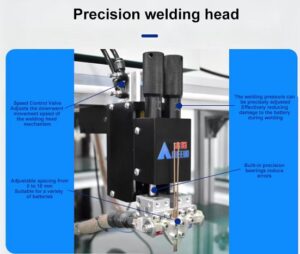
Foot Switch
The foot switch sends a welding signal to the welding power supply and activates the welding head to perform the spot welding operation.
Air Supply Interface
The air supply interface is connected to the pressure regulating valve, which adjusts the air pressure and filters moisture from the compressed air.
The air is then delivered to the solenoid valve. The solenoid valve controls the airflow that drives the air cylinder, which in turn moves the welding head to perform the welding action.