
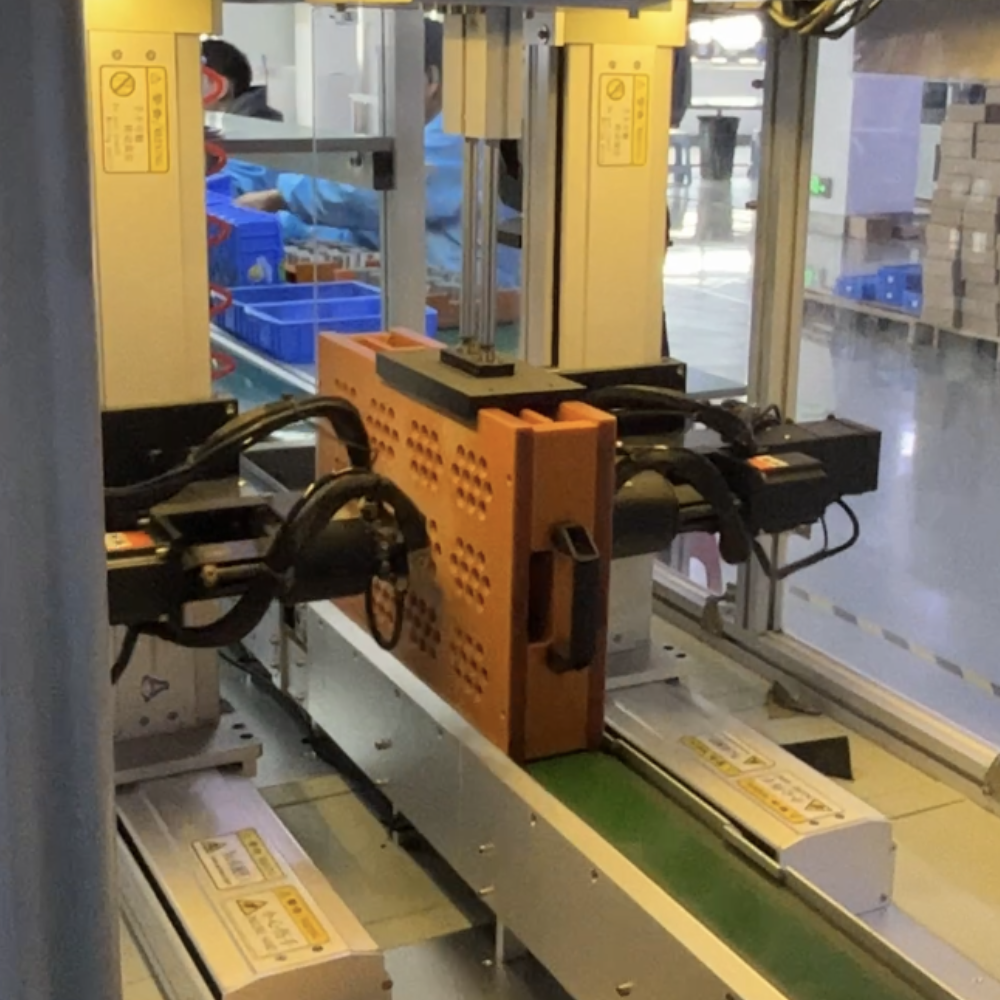
1、Assembly and Welding Method of Cylindrical Lithium Battery PACK
Spot welding (resistance welding) (main method)
Application scenario: The connection between the positive and negative electrodes of cylindrical batteries and nickel/copper plates is the mainstream welding method for cylindrical PACKs.
- Principle: By applying pressure through electrodes and passing high current, the contact area between the tab and the connection plate instantly generates high temperature, enabling diffusion bonding between metal atoms.
- Advantages: Fast welding speed (about 0.1-0.3 seconds per weld point), suitable for mass production; minimal heat-affected zone, low damage to battery body; relatively low equipment cost and easy maintenance.
- Technical specifications: Precise control of welding current (typically 500-3000A), pressure (5-20N), and duration (10-50ms) is essential to prevent under-welding (excessive contact resistance) or over-welding (lead melting or internal battery short circuit). Aluminum oxide copper electrodes are commonly used, requiring regular grinding to maintain conductivity and pressure uniformity.
- Limitations:The surface flatness of the tab is critical. Oxidation or burrs on the positive/negative electrodes may cause poor welding. Single solder joints have limited strength, requiring multiple joints (e.g., 18650 batteries typically use 2-4 joints).
2、Welding Method of Aluminum Shell Lithium Battery PACK
Laser welding (main method)
Application scenario: The connection between aluminum casing battery terminals and busbars (typically aluminum or copper-aluminum composite) constitutes the core welding process in aluminum casing PACKs.
- Principle: Leveraging aluminum’s high reflectivity and thermal conductivity, the system employs green laser (532nm wavelength) or fiber laser (absorption rate enhanced via waveform modulation) to achieve fusion welding between busbars and terminals.
- Advantages: Enables direct welding of dissimilar materials (Al-Al or Al-Cu) without intermediate layers or composite busbars, effectively preventing aluminum oxidation during welding. The process features high efficiency (single weld point completed in under 0.5 seconds), making it ideal for large-scale busbars such as those in power battery modules.
- Technical points: Aluminum shell battery pole is mostly aluminum, laser energy should be controlled to avoid burning through the pole (the thickness of the pole is usually 0.5-1mm); use the “spoon hole” welding mode to ensure the depth of melting (usually 0.3-0.8mm);
- Common methods:Include spot welding (for localized connections) and continuous welding (e.g., edge sealing of busbars). In power battery modules, a hybrid approach combining multi-point spot welding with contour continuous welding is commonly employed to enhance reliability.
3、Welding Method of Soft-pack Lithium Battery PACK
Ultrasonic welding
Application scenario: The most common process in pouch battery PACKs involves multi-layer soldering of tab electrodes (aluminum or nickel-plated copper) or their connection to busbars.
- Principle: Ultrasonic vibrations (transducer frequency 20-35kHz) generate frictional heat at the contact surface of the tabs, enabling solid-state welding without melting.
- Advantages: The tabs do not need pretreatment (such as nickel turning) and can be directly welded to multi-layer aluminum tabs (such as 6-10 layers, each layer thickness 0.08-0.15mm); the welding temperature is low (<200℃), avoiding heat damage to the aluminum plastic film packaging layer (PP layer melting point is about 160℃); the equipment cost is moderate and the welding efficiency is very high (less than 0.2 seconds per soldering point, suitable for mass production).
- Technical specifications: The welding nozzle must be made of wear-resistant materials (e.g., titanium alloy), with a surface pattern designed as either a “mesh” or “strip” to enhance grip strength. A pressure sensor monitors the welding process in real time to prevent under-soldering (insufficient diffusion between tabs) or over-soldering (tab fracture).
- Limitations: The welding strength is significantly affected by the number of tab layers (strength drops markedly beyond 12 layers); high alignment precision is required (alignment deviation must be <0.1mm) to prevent localized overheating.
Laser welding
Application scenarios: The “nickel conversion” process for pouch battery tabs (where aluminum tabs are welded to nickel sheets, then to busbars), or the connection between tabs and thick busbars (e.g., copper busbars).
- Principle: Similar to aluminum-case batteries, but requires lower energy density to prevent tab burn-through.
- Advantages: It significantly enhances the connection strength between tabs and busbars (over 30% higher than ultrasonic welding), making it ideal for high-current discharge applications such as welding thicker busbars.
- Limitations: The soft-pack battery requires strict positioning to prevent electrode deformation caused by vibration during welding.
Comparison and Summary of Three Types of Battery Welding Methods
| Dimension | Cylindrical cell | Aluminum shell battery | Pouch battery |
| Mainstream process | Spot welding (welding of thinner nickel sheets) | Laser welding (aluminum-aluminum / aluminum-copper welding) | Ultrasonic welding (multi-layer pad stacking)/Laser welding |
| Core Challenges | Positioning accuracy and multi-weld consistency | High Reflectivity and Welding of Different Materials | The thin tab is easy to tear and the soft package shell is heat protected |
| Equipment cost | spot welding (low) | Laser welding (high) | Ultrasonic welding (medium)/Laser welding (high) |
| Application scenarios | Electric tools, e-bikes, drone batteries, power banks | Power batteries (e.g., modules for new energy vehicles and large-scale energy storage systems) | Consumer electronics (e.g. mobile phones, tablets), drone batteries |
Common requirements: All welding processes must be accompanied by tensile testing (post-weld tensile strength ≥5N per weld point) and performed in a dry inert gas environment (dew point <-40°C, oxygen content <100ppm) to prevent oxidation in the welding area, which may affect conductivity.
